Largest Promotional Giveaways in Middle East Since 1989
- +971 6 533 1353
- www.mtc.ae
- Store Location

Contact us now!
+971 6 533 1353

Large Format Printing Services
In a world saturated with digital notifications, physical presence matters more than ever. Whether you are aiming to capture foot traffic on a busy city street, dominate a trade show floor, or wrap a corporate vehicle fleet, standard-sized marketing materials simply won’t cut it.
Enter large format printing services—the ultimate solution for high-impact, physically commanding visual communication. This comprehensive guide covers everything you need to know about wide-format printing, its applications, major benefits, and how to choose the right materials to ensure your brand stands out from the competition.
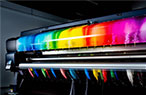
Also known as wide-format printing, large format printing refers to print production that requires specialized machinery to accommodate graphics larger than traditional commercial printing presses can handle. Typically, this includes any print project requiring a roll width from 18 inches to over 100 inches.
Unlike standard printing, which often utilizes sheet-fed offsets, large format printers utilize continuous rolls of substrates or flatbed surfaces to feed massive sheets of vinyl, wood, metal, glass, or textiles directly beneath advanced inkjet printheads.
Roll-to-Roll Printing: Ideal for flexible materials like vinyl banners, paper posters, window films, and vehicle wraps. The material moves seamlessly from one spool to another as it prints.
Flatbed Printing: The material remains completely stationary on a flat table while the printer gantry moves across it. This allows for direct printing onto rigid substrates like foam board, PVC, aluminum dibond, acrylic, and wood, entirely eliminating the need for mounting.
The Core Advantages of Large Format Printing Services
Investing in large-format visual graphics offers distinct business and marketing advantages. When executed properly, wide-format assets provide a lower cost-per-impression than many digital or print media alternatives.
1. Unrivaled Visibility and Brand Awareness
The primary benefit is sheer scale. Large format graphics demand attention. A massive, high-contrast banner or storefront window graphic ensures your marketing message is visible from a distance, capturing the eyes of commuters, pedestrians, and event attendees who would otherwise overlook digital banners or flyers.
2. High Durability for Outdoor Environments
Professional large format print services utilize specialized inks—such as UV-curable, latex, and eco-solvent inks—that are engineered to withstand harsh environmental conditions. These graphics are fade-resistant, water-resistant, and capable of enduring direct sunlight, wind, and rain for months or even years without losing their color saturation.
3. Incredible Substrate Versatility
Modern print technology is no longer constrained to paper or thin cardstock. Large format flatbed printers can print directly onto virtually any flat surface. This flexibility allows businesses to create anything from sleek, professional acrylic office signs to rugged, weather-proof aluminum construction site signage.
4. Cost-Effective Long-Term Advertising
Unlike digital pay-per-click (PPC) ads or billboard rentals that require continuous, recurring payments to keep your message live, a custom large format print is a one-time investment. Once printed and installed, your asset continues to generate thousands of impressions daily at zero ongoing cost.
Best Practices for Designing Wide-Format Graphics
Designing for scale requires a fundamental shift in how you handle file preparation. A file that looks perfect on a laptop screen can quickly become a pixelated mess when blown up to a 10-foot banner.
Prioritize Vector Formats: Whenever possible, build designs using vector paths (
.AI,.EPS, or vector-embedded.PDF). Vectors scale infinitely without ever losing crispness or clarity.Mind Your DPI Target: For raster images (photos), aim for 100 to 150 DPI at full output size. While desktop printing demands 300 DPI, the viewing distance of a large format banner allows a lower DPI to look razor-sharp to the human eye.
Convert to CMYK Color Space: Large format printers operate on a multi-ink system based on CMYK (Cyan, Magenta, Yellow, Key/Black). Designing in RGB can lead to disappointing, muddy color shifts when translated to physical ink.
Design for Viewing Distance: A billboard needs massive text and minimal details to be read in three seconds at 60 mph. Conversely, an indoor retail display can handle fine text and intricate product shots because customers stand inches away.
Main Services
- Offset Printing Service
- UV Printing
- Screen Printing Service
- Pad Printing Service
- Heat Transfer Printing
- Digital Large Format Printing
- Digital Printing Sandblast Effect
- Vinyl Cutting
- Heat Transfer Print and Cut
- Sublimation Printing
- PVC ID Card Printing
- Digital Printing Service
- Commercial Labels & Tags
- Laser Cutting & Engraving
- Crystal Laser 2D / 3D Engraving
- Debossing & Embossing
- Indoor Wall & Desk Signs
- Product Assembly
- Leather Folder Making
- Custom Box Making
- Router and Manual Cutting
- Laser Metal Markings
- Hot Foiling
- Embroidery & Stitching
- Epoxy Coating
- Data Transfer Service