Largest Promotional Giveaways in Middle East Since 1989
- +971 6 533 1353
- www.mtc.ae
- Store Location

Contact us now!
+971 6 533 1353

Professional Heat Transfer Printing Services
In the competitive world of custom branding, businesses, sports teams, and independent designers demand apparel decoration that is vibrant, highly detailed, and cost-effective. While traditional screen printing and embroidery have their place, Heat Transfer Printing Services have emerged as the premier choice for intricate, full-color designs and quick-turnaround custom orders.
Whether you are launching an e-commerce clothing line, ordering promotional merchandise, or updating corporate uniforms, understanding the capabilities of modern thermal transfer technology ensures you get the highest-quality product for your budget.
What is a Heat Transfer Printing Service?
At its core, heat transfer printing is a dual-stage digital decoration method. Instead of applying ink directly onto a garment or substrate, the artwork is first engineered onto a specialized carrier film or transfer paper. Using an industrial-grade heat press, precise combinations of high temperature, exact timing, and intense pressure are applied to permanently bond the design’s pigments into—or onto—the material’s fibers.
The Science Behind the Bond
The process relies on thermosetting polymers or specialized thermal adhesives. When exposed to heat ranging from 300°F to 400°F (150°C to 205°C), the solid adhesive backing on the transfer film temporarily liquifies, flows into the microscopic weave of the fabric, and instantly resolidifies under pressure. This creates a highly resilient mechanical and chemical bond that resists cracking, peeling, and fading through standard wash cycles.
The 3 Main Types of Heat Transfer Technology
Not all heat transfers are created equal. Depending on your fabric type, artwork complexity, and production volume, a professional printing service will deploy one of four distinct technical methods.
1. Direct-to-Film (DTF) Transfers
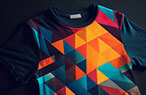
The leading standard for modern custom apparel. DTF involves printing full-color CMYK+White digital inks onto a clear PET film, which is then coated with a hot-melt adhesive powder.
Best For: Complex, multi-colored graphics, fine lines, and photographic gradients.
Compatible Materials: Cotton, polyester, nylon, canvas, and poly-blends.
2. Dye Sublimation Printing
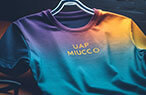
Unlike topical films, sublimation chemically transforms ink into a gas that infuses the physical polyester yarns.
Best For: All-over prints, performance activewear, and hard substrates like mugs or aluminum panels.
Compatible Materials: 100% white or light-colored polyester fabrics only.
3. Heat Transfer Vinyl (HTV)
A plotter mechanically cuts solid-colored or textured vinyl sheets (such as metallic, glitter, or reflective films), which are then manually “weeded” and pressed.
Best For: Bold typography, simple athletic jersey numbers, and high-visibility safety gear.
Compatible Materials: Cotton, polyester, leather, and blends.
Comprehensive Pros & Cons of Heat Transfer Printing
To help you make an informed procurement decision, here is a transparent, data-driven comparison of how heat transfer printing scales against industry standards.
The Advantages (Pros)
Unlimited Color Palette & Detail: Unlike traditional screen printing, which charges per individual color layer, heat transfers easily replicate complex photorealistic gradients, fine text, shading, and multi-colored logos for a flat setup cost.
Unmatched Material Versatility: It seamlessly adheres to rigid surfaces, synthetic textiles, water-resistant outerwear, performance synthetics, and organic cotton.
Ultra-Low Order Minimums: Because it bypasses the intensive chemical screen-burning setup required by screen printing, it is highly economical for small batches, custom prototypes, and on-demand e-commerce fulfillment.
Placement Flexibility: Easily decorates complex regions that screen printing frames cannot physically access, such as shirt sleeves, inner neck labels, hat crowns, pocket flaps, and zipper tracks.
The Limitations (Cons)
Diminishing Returns on Bulk Orders: Because every single garment must be manually aligned and individualistically stamped under a heat press, labor costs do not scale down as aggressively as automated screen printing for orders exceeding 500 units.
Altered Fabric Hand-Feel: Thick vinyl or heavy DTF prints can create a localized “plastic-like” patch over the fabric. This can slightly restrict breathability in high-performance activewear compared to water-based inks.
Sensitivities to Extreme Heat: Washing or drying garments at ultra-high commercial laundry temperatures can degrade the internal adhesive over time, causing premature cracking or edge lifting if improper care is taken.
The Step-by-Step Commercial Production Process
To guarantee flawless application, commercial printing facilities bypass manual irons and desktop tools, adhering to a strict, synchronized multi-step production pipeline:
Graphic designers convert raster files into high-resolution formats (minimum 300 DPI). Transparent backgrounds are hard-coded, and a white ink backing layer is structurally mapped to ensure the design remains completely opaque on dark-colored fabrics.
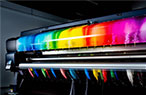
The optimized artwork is printed in reverse (mirrored) onto specialized transfer film or paper using commercial wide-format digital printers equipped with high-density textile inks.
For DTF transfers, a specialized TPU (Thermoplastic Polyurethane) adhesive powder is uniformly shaken over the wet ink. The film then passes through a calibrated convection curing oven to melt the powder into a uniform, solid binding layer.
The substrate is pre-pressed to eliminate moisture and wrinkles. The transfer film is aligned, and a heavy-duty pneumatic heat press applies exact heat (typically 320°F) and medium-to-high pressure (4-5 bar) for a strict duration of 12 to 15 seconds.
Depending on the chemical formulation of the transfer system, the film is peeled either immediately while hot (Hot Peel) or allowed to completely drop in temperature (Cold Peel) to preserve crisp, razor-sharp edge definition.
Main Services
- Offset Printing Service
- UV Printing
- Screen Printing Service
- Pad Printing Service
- Heat Transfer Printing
- Digital Large Format Printing
- Digital Printing Sandblast Effect
- Vinyl Cutting
- Heat Transfer Print and Cut
- Sublimation Printing
- PVC ID Card Printing
- Digital Printing Service
- Commercial Labels & Tags
- Laser Cutting & Engraving
- Crystal Laser 2D / 3D Engraving
- Debossing & Embossing
- Indoor Wall & Desk Signs
- Product Assembly
- Leather Folder Making
- Custom Box Making
- Router and Manual Cutting
- Laser Metal Markings
- Hot Foiling
- Embroidery & Stitching
- Epoxy Coating
- Data Transfer Service